
Introduction
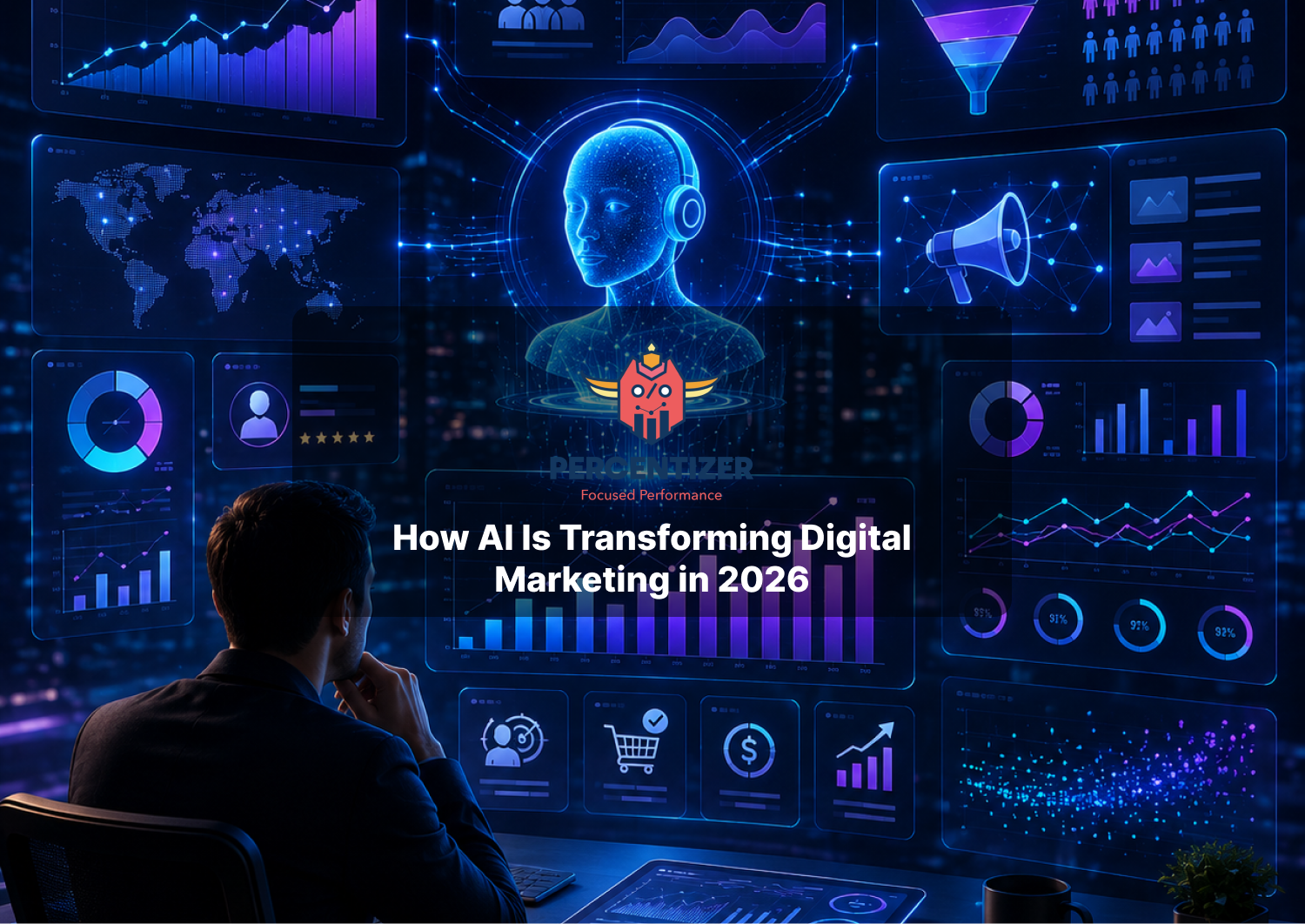
Artificial intelligence is no longer a futuristic concept in digital marketing. In 2026, AI has become an important part of how businesses understand customers, create content, optimize campaigns, and make marketing decisions.
From AI-powered search and personalized customer experiences to automated workflows and predictive analytics, businesses are increasingly using artificial intelligence to make marketing more efficient and data-driven.
The biggest change is not simply that marketers are using AI tools to create content faster. AI is becoming part of the decision-making process itself, helping businesses understand customer intent, identify opportunities, and respond to changing behavior.
1. AI Is Changing How Customers Search
Search behavior is evolving rapidly. Customers are increasingly using conversational and AI-powered search experiences to ask more detailed questions and explore products, services, and brands.
This means businesses need to think beyond traditional keyword rankings. Content should be structured around real customer questions, useful information, clear answers, and trustworthy expertise.
Google’s 2026 marketing outlook highlights the growing importance of conversational and multimodal search, while marketers are increasingly adapting their content for AI-powered discovery.
This shift has created growing interest in Generative Engine Optimization (GEO) and Answer Engine Optimization (AEO)—approaches that help businesses increase their visibility across AI-generated answers and conversational search experiences.
2. AI Enables Smarter Personalization
Customers expect brands to understand their needs and provide relevant experiences.
AI allows businesses to analyze customer behavior, preferences, interactions, and historical data to create more personalized marketing experiences.
For example, AI can help a business:
- Recommend relevant products or services
- Personalize email campaigns
- Segment audiences automatically
- Predict customer interests
- Customize advertising messages
- Identify customers who are more likely to convert
According to HubSpot’s 2026 marketing research, AI-powered personalized content is one of the leading marketing trends, while the majority of surveyed marketers report positive results from personalized or segmented experiences.
3. Marketing Automation Is Becoming More Intelligent
Marketing automation is not new, but AI is making it significantly more powerful.
Instead of simply following predefined rules, AI-powered systems can analyze information and help determine what action should happen next.
For example, an automated marketing system can identify a high-intent lead, recommend the most relevant content, trigger a personalized email, and help the sales team prioritize the lead.
This allows marketing teams to spend less time on repetitive tasks and more time on strategy, creativity, and customer relationships.
4. Predictive Analytics Helps Marketers Make Better Decisions
One of the strongest applications of AI is predictive analytics.
Rather than only analyzing what happened in the past, AI can identify patterns in historical and real-time data to help businesses anticipate future outcomes.
Predictive analytics can be used to:
- Forecast customer demand
- Identify potential high-value customers
- Predict churn
- Estimate campaign performance
- Optimize marketing budgets
- Identify sales opportunities
This turns marketing from a reactive activity into a more proactive business function.
5. AI Is Improving Advertising Performance
AI is increasingly integrated into advertising platforms to help marketers optimize targeting, bidding, creative variations, and campaign performance.
Instead of manually managing every campaign element, marketers can provide platforms with high-quality data, creative assets, conversion signals, and business objectives while AI helps optimize delivery.
The marketer’s role therefore becomes less about manually adjusting every setting and more about providing the right strategy, data, creative direction, and measurement framework.
6. Content Creation Is Becoming Faster—but Quality Still Matters
Generative AI has dramatically changed content production.
Businesses can use AI to generate ideas, outlines, drafts, variations, summaries, and creative concepts in significantly less time.
However, speed should not come at the expense of quality.
AI-generated content still needs human review, brand alignment, factual verification, originality, and a clear understanding of the target audience.
The strongest marketing strategies in 2026 are not simply about producing more content. They are about producing more relevant, useful, and trustworthy content.
7. Data Quality Is Becoming More Important
AI is only as effective as the data it receives.
Poor-quality, incomplete, outdated, or fragmented customer data can lead to inaccurate insights and ineffective personalization.
That is why businesses need to focus on building reliable data foundations, including:
Clean customer databases
Accurate tracking
First-party data collection
Clear conversion events
Integrated marketing platforms
Consistent reporting
Experian’s 2026 marketing research highlights the increasing importance of first-party data as marketers connect AI, measurement, and customer activation.
8. The Human Role in Marketing Is Not Disappearing
AI can analyze massive amounts of data and automate many tasks, but successful marketing still requires human creativity, strategy, empathy, and judgment.
AI can help answer what is happening and identify possible patterns. Marketers still need to understand why those patterns matter and what the business should do next.
The future of digital marketing is therefore not AI replacing marketers. It is marketers using AI to become more strategic, efficient, and data-driven.
Conclusion
AI is transforming digital marketing by changing how businesses understand customers, create content, manage campaigns, and make decisions.
In 2026, businesses that treat AI as simply a content-generation tool may miss its biggest potential. The real opportunity lies in combining AI, data, automation, personalization, and human strategy